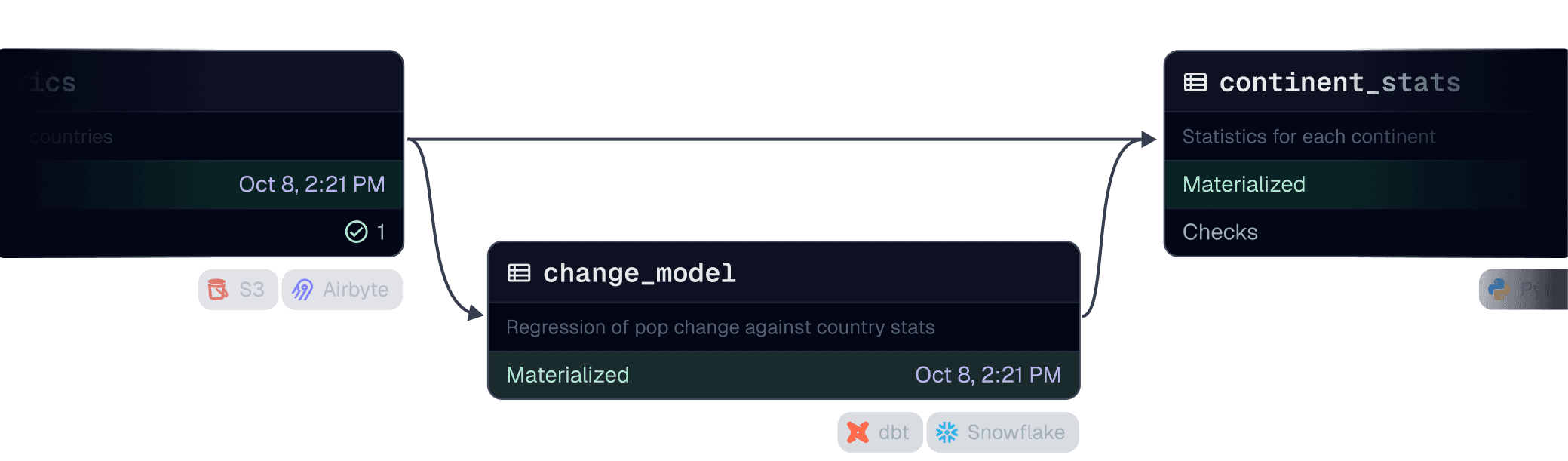
Accelerate
Engineers building data pipelines in Dagster are 2x more productive than those using Airflow and benefit from a modern SDLC and delightful developer experience.


Dagster accelerates your data teams, unifies all of your Airflow instances, and simplifies your stack into a single control plane.
Dagster fits into the way modern teams work, with the flexibility, visibility, and guardrails enterprises need to move fast without breaking things. Here’s what makes it a no-brainer for the teams we work with:
Engineers building data pipelines in Dagster are 2x more productive than those using Airflow and benefit from a modern SDLC and delightful developer experience.
Dagster supercharges cross-team collaboration with federated orchestration, observability and lineage across Dagster pipelines and all Airflow instances.
Dagster reduces the number of tools in the data stack through its built-in data cataloging, observability, data quality, and cost management features.

“You won't need to run a bunch of complicated infrastructure like docker containers to run this locally like you would with Airflow.”Rob TeeuwenData Science Lead
1 / 5
Modern data engineering requires a fresh approach
Dagster brings modern software engineering practices to data orchestration with lightning-fast local development, and comprehensive unit-testing. Build, test, and debug your data pipelines on your laptop because data engineering is software engineering.
Learn More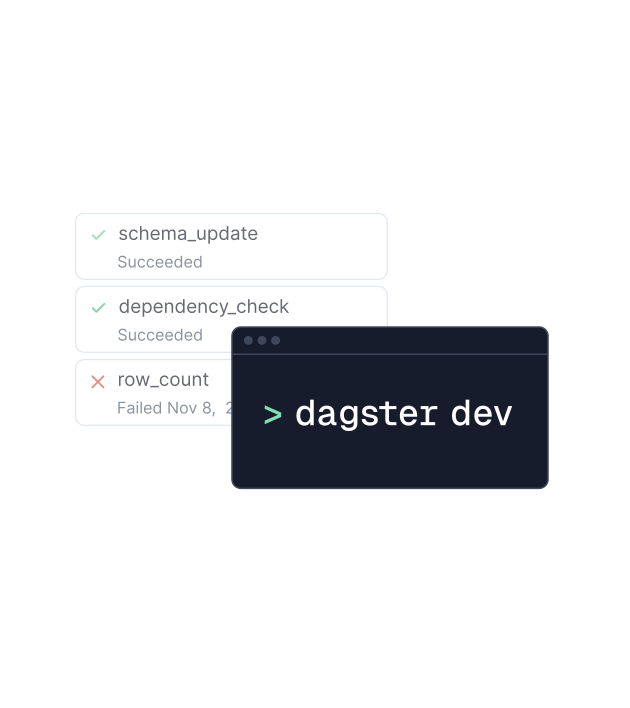
Skip the painful Airflow 3 rewrite and modernize your data platform in 3 easy steps
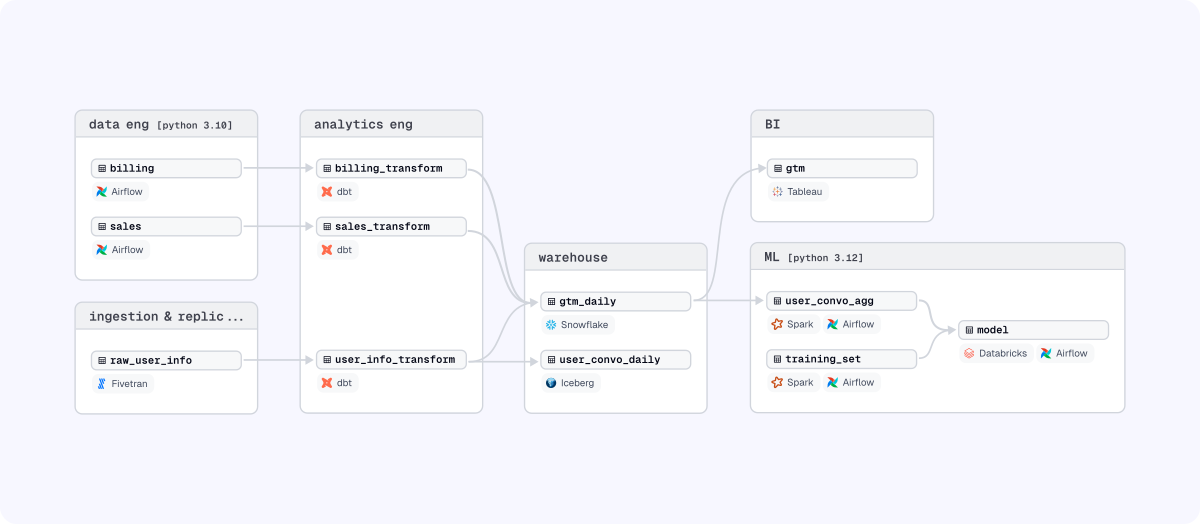
With just a few lines of code, you can observe and govern your Airflow DAGs from all your Airflow instances in a single location. Break down the data silos without changing a single line of Airflow code.
Build new data pipelines with Dagster's modern developer experience, or add data quality checks to existing Airflow DAGs. All without touching the existing Airflow code. Migrate with Airlift.
With Dagster's rich observability and operational tooling, you'll no longer need several components of your stack. And as data pipelines are incrementally migrated from Airflow to Dagster, you can shut down your legacy Airflow instances.
Dagster goes well beyond Airflow and offers rich capabilities for data management
Dagster's data catalog lets technical stakeholders discover data assets and explore their lineage, operational state, and other metadata.
Learn MoreYou can incrementally add data quality checks to your existing Airflow DAGs, observe the health of your data pipelines, and make runtime decisions based on data quality.
Learn MoreDagster integrates a rich cost management suite, enabling both data platform owners and their stakeholders to manage their spend on data tools like Snowflake.
Learn MoreDagster provides tooling to incrementally migrate DAGs from legacy Airflow instances to modern Dagster code. We also provide professional services to migrate your DAGs for you.
Learn MoreWe couldn't load this form. You can reload the page or use the alternative contact option.
The latest news, technologies, and resources from our team.
Learn how Dagster uses AI to build custom demos that deliver a personalized experience for every customer.
Learn the patterns, trade-offs, and production-tested strategies for building multi-tenant data platforms with Dagster.
Learn how to build a cross-workspace control plane for Databricks using Dagster — connecting multiple workspaces, dbt, and Fivetran into a single observable asset graph with zero code changes to get started.
Dagster is a data orchestration platform that treats pipelines as software: you get strong local development, testing, and a unified view of assets and runs, while still being able to observe and govern existing Airflow DAGs from one place.
Apache Airflow is an open-source workflow orchestration tool that lets teams schedule and monitor data pipelines as directed acyclic graphs (DAGs).
Yes. Dagster emphasizes fast local development and unit testing so you can build and debug pipelines on a laptop. Teams that want to operate their own stack can use OSS deployment.
Branch deployments give you isolated environments that mirror production so you can test pipeline changes end-to-end before merging. Dagster covers this alongside multi-tenant deployment patterns, and Dagster+ is the managed product surface for teams that prefer a hosted control plane.
Yes. You can use Dagster’s asset-oriented Python model or declarative YAML-style workflows via Dagster Components, which pairs with the core concepts guides when you need terminology and mental models.
Dagster integrates external processes through guides such as external pipelines so orchestration stays observable without forcing a single runtime. The integrations catalog lists first-class connectors, and Dagster Pipes can bridge orchestration with jobs running elsewhere.
Dagster's data catalog is available directly in the platform, where technical stakeholders can discover data assets, explore their lineage, operational state, and other metadata.
Data quality checks surface in your pipeline observability views, where you can monitor the health of your data pipelines and make runtime decisions based on data quality results, including checks added to existing Airflow DAGs.
Cost management is built into the Dagster platform, giving both data platform owners and their stakeholders visibility into spend on data tools like Snowflake.
Migrating from Airflow to Dagster is designed to be incremental and low-risk. You can start by observing and governing your existing Airflow DAGs from within Dagster without changing any Airflow code, then gradually migrate pipelines over time at your own pace. For a step-by-step guide, check out our migration guide. If you'd prefer hands-on help, contact us about our professional migration services.
Dagster is open source, and you can self-host or use Dagster+ for managed, enterprise-grade deployment.
Dagster+ is Dagster’s fully managed offering with features like Insights and enterprise controls for teams that want a hosted control plane. You can sign up for a free 30-day trial here.
Dagster University is a great place to learn about Dagster essentials. We have a quickstart guide that walks you through your first pipeline in Python with minimal setup.